What Is Online Slot RTP? Meaning, Calculation and Volatility
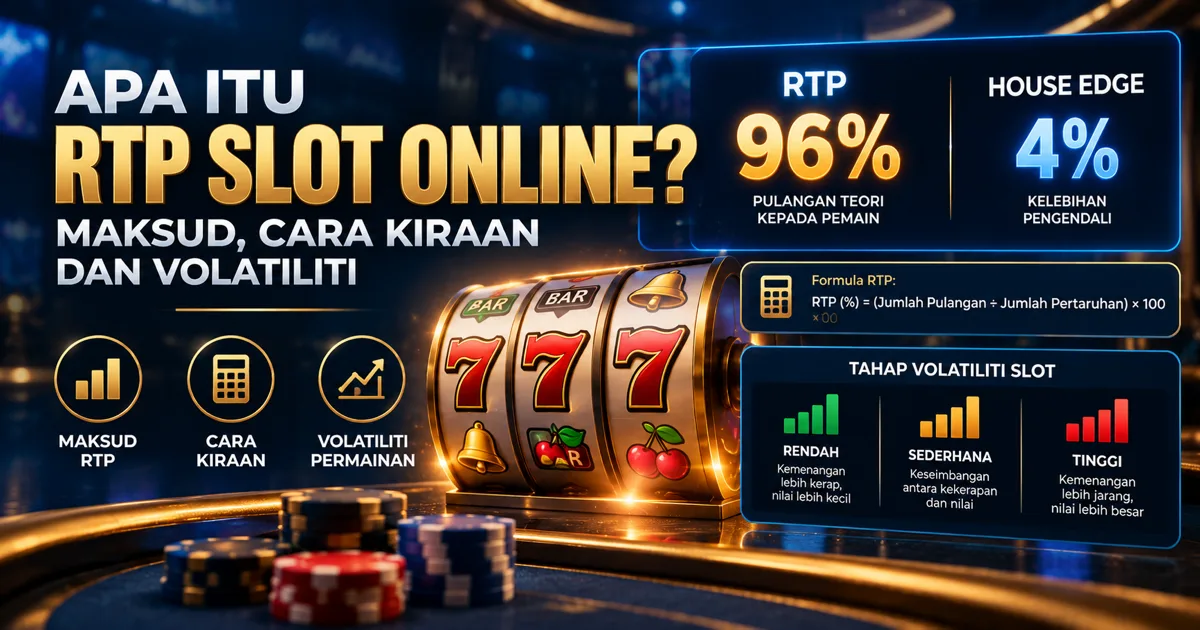
Have you ever seen the term 96% RTP or 98% RTP when reading information about online slot games? Many users have come across these figures, but not everyone understands what RTP really means and how it relates to game outcomes.
Some assume that a high RTP means a greater chance of winning on every spin. Others believe that a slot machine will produce a win after several losses.
In fact, both assumptions can be misleading.
RTP is a statistical measure that describes a game's theoretical return over the long term. It is not a prediction of winnings for a single gaming session.
In this article, we will understand the meaning of online slot RTP, how it is calculated, the difference between RTP and volatility, and several common misconceptions.
What Is Online Slot RTP?
RTP stands for Return to Player, which is the theoretical percentage returned to players based on the total amount wagered in a game.
For example, a slot game with a 96% RTP has a theoretical return of RM96 for every RM100 wagered overall in the long term.
However, this figure does not mean that every individual who wagers RM100 will receive RM96 back.
RTP is a statistical value generally obtained through mathematical models and game testing using a very large number of spins.
The result of each gaming session can differ significantly from the stated RTP.
What 96% RTP Means in Slot Games
Imagine a slot game has a theoretical RTP of 96%.
Mathematically, this means the game is designed with an average theoretical return of 96% of total bets over the long term.
The remaining 4% is the operator's mathematical advantage, commonly referred to as the house edge.
However, this relationship only describes a statistical expectation.
It does not mean that players will lose exactly 4% of their money every time they play.
How Is Online Slot RTP Calculated?
The basic RTP formula is:
RTP (%) = (Total Returns ÷ Total Bets) × 100
For example, imagine a game simulation produces the following results:
- Total accumulated bets: RM100,000
- Total returns to players: RM96,000
The calculation:
(RM96,000 ÷ RM100,000) × 100 = 96%
Therefore, the RTP observed in the simulation is 96%.
However, there is a difference between theoretical RTP and observed actual RTP.
Theoretical RTP is determined through the game's mathematical model, while actual RTP can vary depending on the outcomes that occur over a particular period.
Is RTP Calculated Based on One Gaming Session?
No.
RTP should not be used to predict the result of one gaming session.
For example, if someone plays 20 spins on a game with a 96% RTP, they will not necessarily receive a return equal to 96% of the amount wagered.
They may receive a higher return, a lower return or no return at all.
This is why RTP needs to be understood as a long-term measure, not a guarantee of an individual's results.
Slot RTP vs Volatility: What Is the Difference?
RTP and volatility are two different concepts in online slot games.
Although both relate to the mathematical structure of a game, each describes something different.
| Aspect | RTP | Volatility |
|---|---|---|
| Meaning | Theoretical return percentage | Level of variation in game outcomes |
| Focus | Long-term average return | Pattern and size of wins |
| Example | 96% RTP | Low, medium or high volatility |
| Guarantees a win? | No | No |
| Predicts a particular session? | No | No |
Low Volatility
Games with low volatility are generally designed with a pattern of more frequent wins that are relatively smaller in size.
However, this does not mean players will receive wins consistently.
Medium Volatility
Medium volatility describes a level of variation between the low and high categories.
Winning patterns still depend on the game's mathematical design and random outcomes.
High Volatility
Games with high volatility generally have greater variation in outcomes.
This means there may be long periods without a win, alongside the potential for larger outcomes when a win occurs.
However, the potential for a large win does not make the game more profitable.
To understand game categories and related terms, readers can refer to the Wingiler44 slot games guide.
Does a High RTP Mean a Slot Is Easier to Win?
Not necessarily.
This is one of the most common misconceptions about online slot RTP.
For example, compare the following two games:
Game A
- Theoretical RTP: 96%
- Volatility: Low
Game B
- Theoretical RTP: 97%
- Volatility: High
Although Game B has a higher theoretical RTP, this does not mean players will get wins more easily or more quickly.
Differences in volatility can produce very different experiences of the outcomes.
In addition, a one percentage point difference in RTP does not allow anyone to predict the result of a particular gaming session.
A high RTP does not guarantee wins, profits or reduced losses in an individual session.
Does Slot RTP Change Over Time?
This question often arises when users see claims about slots being “hot” or “cold”.
In general, theoretical RTP is part of a game's mathematical configuration.
However, some games may have several RTP configurations set by the developer or operator.
Therefore, the RTP displayed for a game with the same name may differ between platforms or specific versions.
This does not mean RTP changes automatically over time or based on the number of losses a player has experienced.
Can RTP Show When a Slot Will Pay?
No.
RTP cannot be used to determine when the next win will occur.
If a game uses a Random Number Generator (RNG) system, the result of each spin is produced according to the established random mechanism.
In a typical RNG slot game, previous outcomes do not allow players to predict the result of the next spin.
5 Misconceptions About Online Slot RTP
The following are several assumptions commonly found in discussions about slot games.
Myth 1: 96% RTP Means RM100 Will Return RM96
Fact: RTP is a long-term theoretical average. It is not a guaranteed return for every RM100 wagered.
Myth 2: A Slot Will Win After Many Losses
Fact: Previous losses do not mean the next win is certain to occur.
Myth 3: A High RTP Guarantees a Profit
Fact: Even with a higher theoretical RTP, the game can still produce losses. An RTP below 100% also indicates the operator's mathematical advantage over the long term.
Myth 4: Low Volatility Means No Risk
Fact: All volatility categories still involve uncertainty and the risk of losing money.
Myth 5: RTP Can Be Used to Predict the Time of a Win
Fact: RTP does not provide information about a particular time or spin that will produce a win.
How Do You Check a Game's RTP Information?
RTP information is sometimes displayed in the help section, game information or documents published by the game developer.
However, not all platforms provide the same information.
When reading RTP information, it is important to distinguish between:
Theoretical RTP: A value determined based on the game's mathematical model.
Actual RTP: The return observed from game outcomes over a particular period.
Volatility: A measure of the variation in outcomes that may occur.
In addition, users should be cautious about websites or individuals who claim to be able to predict wins based on current RTP.
Such claims do not necessarily have a reliable statistical basis.
To learn more about the brand and game categories, readers can visit Wingiler44.
RTP and House Edge: How Are They Related?
RTP and house edge have a close mathematical relationship.
In an appropriate game model, the basic relationship is:
House Edge (%) = 100% − RTP (%)
For example:
| Theoretical RTP | House Edge |
|---|---|
| 94% | 6% |
| 95% | 5% |
| 96% | 4% |
| 97% | 3% |
| 98% | 2% |
This table shows the mathematical relationship between RTP and house edge.
However, these values do not mean an individual player will lose the same amount in every gaming session.
Short-term differences in outcomes can still occur.
Readers who want to understand other game categories can view the casino game categories page.
Why Is Understanding RTP Important?
Understanding RTP helps users evaluate game information more accurately.
It can also reduce the misconception that game outcomes can be predicted through certain patterns.
However, knowledge of RTP does not eliminate financial risk.
A person should not use RTP as a reason to increase bets, chase losses or assume a win will occur after several losses.
Casino games should not be regarded as a source of income or a way to solve financial problems.
For information about risk management and spending limits, read the Wingiler44 responsible gaming guide.
Frequently Asked Questions About Online Slot RTP
1. What does RTP mean in online slots?
RTP stands for Return to Player, which is a game's theoretical return percentage based on the total amount wagered over the long term.
2. Is 96% RTP good?
A 96% RTP means the game's theoretical return is 96% over the long term. However, this figure does not guarantee a win or a particular return to an individual player.
3. Does 98% RTP guarantee a win?
No. A 98% RTP is still a long-term statistical value and cannot be used to predict the result of one gaming session.
4. What is the difference between RTP and slot volatility?
RTP describes the average theoretical return, while volatility describes the level of variation in outcomes and winning patterns.
5. Can slot RTP change?
Some games have several RTP configurations. However, theoretical RTP does not necessarily change over time or based on a player's previous outcomes.
6. Will a slot pay after many losses?
Not necessarily. In a typical RNG slot game, previous outcomes do not guarantee the result of the next spin.
7. Can RTP be used to predict wins?
No. RTP is a long-term statistical measure, not a tool for predicting wins.
Conclusion
Online slot RTP is an important concept for understanding how a slot game's theoretical return is calculated.
Although figures such as 96% or 98% RTP are often displayed in game information, they do not mean that every player will receive a return according to those percentages.
RTP, volatility and house edge describe different mathematical aspects, but none can guarantee an individual game's outcome.
By understanding these differences, readers can evaluate game information more accurately and avoid misconceptions about the chances of winning.
Note: This article is provided for educational and general information purposes. RTP and volatility do not guarantee a win. Gambling activities involve financial risk and are subject to applicable laws and age restrictions.